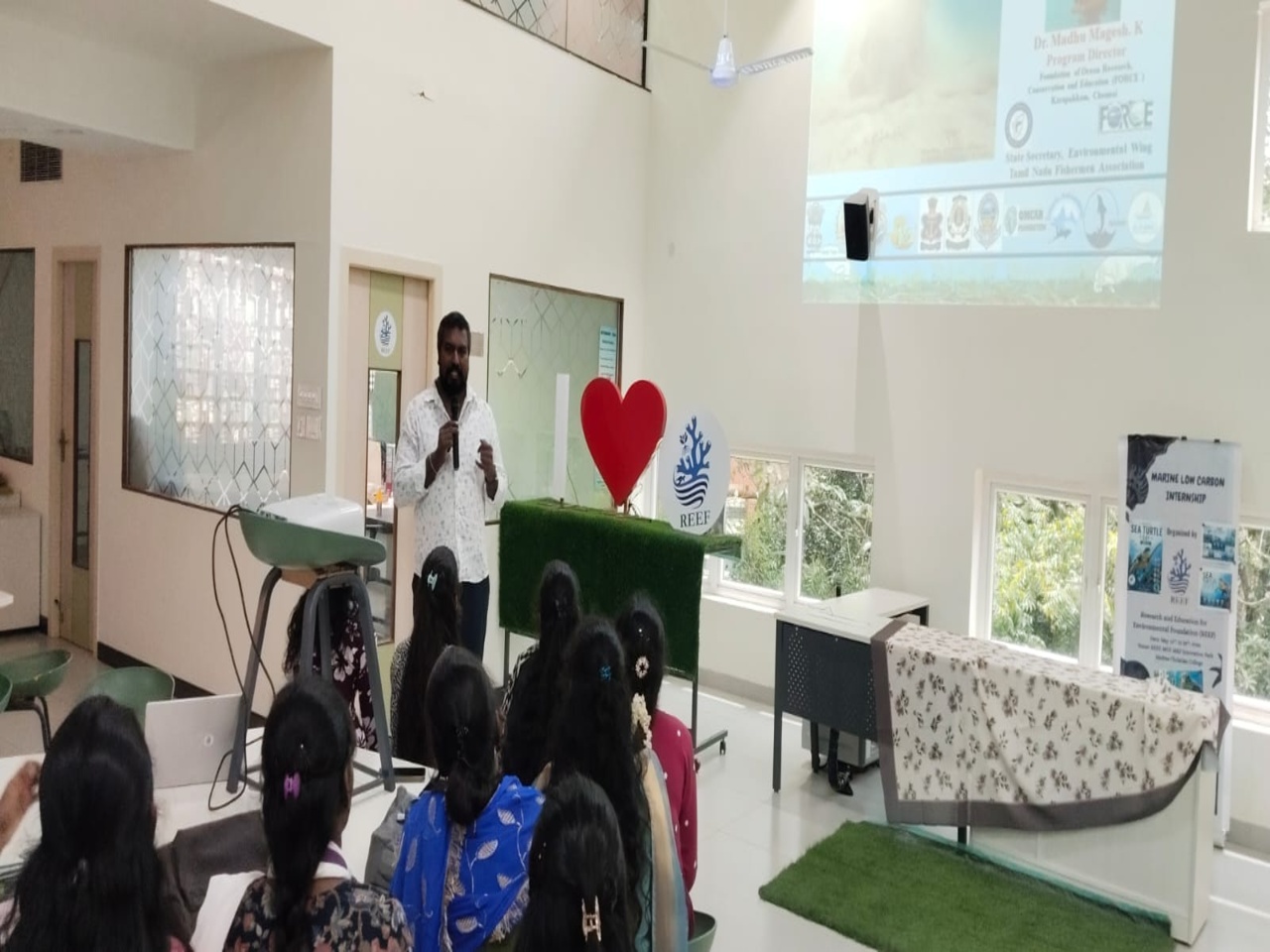
Dugong Conservation by Dr. Mathumagesh
Participants: REEF Marine Low Carbon Internship Participants
Resource Person: Dr. Mathumagesh
Date: 30 May 2026
Venue: Madras Christian College (MCC), Tambaram, Chennai
Theme: Dugong Conservation
Focus: Marine Biodiversity & Seagrass Ecosystems
Scope
To provide participants with a comprehensive understanding of dugong biology, seagrass ecosystems, marine biodiversity, and conservation challenges while emphasizing the importance of sustainable coastal ecosystem management, blue carbon ecosystems, and marine wildlife conservation. The session also aimed to strengthen awareness of climate resilience through the protection of endangered marine species and their habitats.
Content
As part of the REEF Marine Low Carbon Internship 2026, an expert lecture on Dugong Conservation was delivered by Dr. Mathumagesh, who shared his knowledge and field experience on conserving one of India's most endangered marine mammals. The session introduced participants to dugong ecology, their dependence on seagrass ecosystems, and the conservation challenges affecting their survival along the Indian coastline.
Dr. Mathumagesh explained the biological characteristics of dugongs, including their feeding behaviour, reproductive biology, habitat requirements, and ecological significance. Participants learned about dugong distribution in the Gulf of Mannar, Palk Bay, Gulf of Kutch, and the Andaman & Nicobar Islands, emphasizing these regions as critical habitats requiring long-term conservation and scientific monitoring.
The lecture highlighted the growing threats to dugong populations, including illegal hunting, accidental fishing-net entanglement, boat strikes, habitat degradation, pollution, and the destruction of seagrass meadows due to unsustainable coastal development. Through practical examples and conservation case studies, participants gained a deeper understanding of marine ecosystem management and biodiversity conservation.
Key Topics Covered
Dugong Biology
Understanding dugong anatomy, feeding behaviour, ecology and reproduction.
Seagrass Ecosystems
Importance of seagrass meadows for dugongs, fisheries and blue carbon.
Distribution
Major dugong habitats across India's coastal ecosystems.
Conservation
Protection strategies for endangered marine mammals and coastal habitats.
Major Dugong Habitats in India
Western & Southern India
- Gulf of Mannar
- Palk Bay
- Gulf of Kutch
Island Ecosystems
- Andaman Islands
- Nicobar Islands
- Seagrass Meadows
Major Conservation Challenges
- Illegal Hunting
- Fishing Net Entanglement
- Boat Strikes
- Habitat Degradation
- Pollution
- Loss of Seagrass Meadows
- Habitat Protection
- Scientific Monitoring
- Community Participation
- Marine Protected Areas
- Seagrass Restoration
- Sustainable Coastal Management
Importance of Seagrass Ecosystems
Participants learned that healthy seagrass ecosystems provide essential habitat for dugongs, support marine biodiversity, improve fisheries productivity, store significant amounts of blue carbon, and strengthen coastal resilience against climate change. Protecting seagrass ecosystems is therefore critical for conserving endangered marine mammals and maintaining sustainable coastal ecosystems.
Learning Outcome
By the end of the session, participants developed a clear understanding of dugong biology, habitat requirements, conservation challenges, and the ecological value of seagrass ecosystems. The lecture enhanced awareness of marine biodiversity conservation and inspired participants to contribute towards the protection of endangered marine species through research, education, and sustainable coastal management.
Key Takeaways
Dugong Biology
Understanding the ecology, feeding behaviour and habitat requirements of dugongs.
Seagrass Conservation
Importance of protecting seagrass ecosystems for biodiversity and blue carbon.
Marine Biodiversity
Role of dugongs as indicators of healthy coastal ecosystems.
Climate Resilience
Marine conservation supports sustainable coastal management and climate resilience.
Activity Gallery