Life Cycle of a Sea Turtle: From Egg to Ocean Traveller
Introduction
The life of a sea turtle begins on a sandy beach, but its journey soon takes it into the vast ocean. From a tiny egg buried beneath the sand to a mature turtle travelling between feeding grounds and nesting beaches, every stage of the sea turtle life cycle is shaped by remarkable adaptations and environmental challenges.
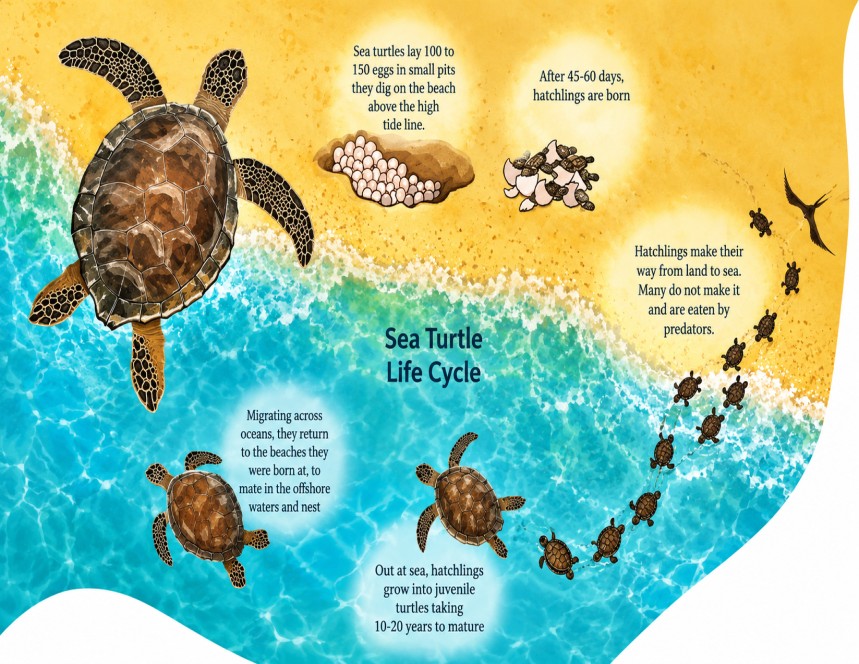
Sea Turtle Life Cycle: From Egg to Adult
Sea turtles spend different stages of their lives in different habitats. Their journey may include nesting beaches, coastal waters, open oceans, seagrass meadows and coral reef environments. Understanding the life cycle of sea turtles helps us appreciate why protecting both marine and coastal habitats is essential for their survival.
Stage 1: The Sea Turtle Egg
The life cycle begins when an adult female comes ashore to lay her eggs. The nesting beach is a critical part of the reproductive cycle because the next generation of turtles develops beneath the sand.
Inside the nest, the developing embryos remain protected from many dangers in the marine environment. However, nests can still be affected by coastal disturbance, predators, environmental conditions and human activities. This makes the protection and monitoring of nesting beaches an important part of sea turtle conservation.
The nesting beach is much more than a place where eggs are deposited. It is the starting point of a journey that can eventually take hatchlings thousands of kilometres across the ocean.
Stage 2: Hatchling – The Journey Begins
After developing inside the egg, a hatchling eventually emerges from the nest and begins one of the most challenging stages of its life. The tiny turtle must make its way across the beach and reach the ocean.
This short journey can be dangerous. Artificial lighting near beaches can disorient hatchlings, while coastal development and human disturbance can alter their natural environment. Reaching the ocean is only the beginning of their journey.
Once in the water, hatchlings enter a completely different world. They begin life as tiny ocean travellers, facing predators, changing environmental conditions and other threats as they grow.
Stage 3: Juvenile Sea Turtle
The juvenile stage can involve extensive movement through marine environments. Young sea turtles may spend time in offshore waters before moving into coastal habitats where food and shelter are available.
Depending on the species, juveniles may use habitats such as seagrass meadows, coral reef environments and coastal waters. These habitats provide important feeding opportunities and contribute to their growth and development.
This stage is particularly important because the turtle must survive long enough to reach maturity. Marine pollution, fishing gear, habitat degradation and other human pressures can affect turtles during this period.
Stage 4: Adult Sea Turtle
After years of growth, a sea turtle eventually reaches adulthood. Adult turtles become important participants in marine ecosystems and may travel between feeding grounds, breeding areas and nesting beaches.
Different species have different ecological roles. Green turtles interact with seagrass ecosystems, hawksbill turtles feed on sponges associated with coral reefs, and leatherbacks are important predators of jellyfish. These relationships demonstrate that adult sea turtles contribute to the functioning of marine ecosystems.
Adult sea turtles can also undertake remarkable long-distance migrations. Some can travel hundreds or thousands of kilometres between different habitats, making their survival dependent on healthy and connected marine environments.
Stage 5: Reproduction and Return to Nesting Areas
When adult sea turtles reach reproductive maturity, they return to breeding and nesting areas. Some turtles show strong connections to the regions where they began life, with magnetic information believed to contribute to their remarkable navigation abilities.
Scientists have found that sea turtles can detect characteristics of Earth's magnetic field. This ability may help them navigate across large areas of ocean and return towards their natal regions.
The cycle then begins again. Adult females return to suitable nesting beaches, lay eggs, and a new generation begins its journey from the sand towards the sea.
The Complete Sea Turtle Life Cycle
Although this looks like a simple cycle, each stage involves different habitats, behaviours and threats. A turtle may depend on a nesting beach during its early and reproductive stages while relying on completely different marine environments for feeding and growth.
This is why effective sea turtle conservation must protect the entire life cycle rather than focusing on just one stage.
Threats at Different Life Stages
Sea turtles face different challenges throughout their lives. Eggs and hatchlings can be affected by beach disturbance and artificial lighting, while juveniles and adults face threats such as plastic pollution, fishing gear, bycatch, vessel activity and habitat degradation.
Climate change can also influence the environmental conditions experienced by sea turtles. Because their lives are connected to both marine and coastal ecosystems, changes in either environment can have consequences for their survival.
Protecting sea turtles therefore requires a combination of nesting beach protection, marine conservation, pollution reduction, responsible fishing practices, research and community awareness.
REEF and Sea Turtle Conservation
The Institute of Sea Turtle Conservation (ISC), an initiative of the Research & Education for Environmental Foundation (REEF), focuses on protecting sea turtles and their nesting habitats along the Pulicat coast. REEF's work includes nesting beach monitoring, conservation research, biodiversity assessments, rescue and protection of stranded turtles, awareness programmes and student training.
These activities help connect scientific research with practical conservation. Field monitoring can provide valuable information about nesting activity and biodiversity, while education and community participation can help create greater awareness about the importance of protecting coastal ecosystems.
For students and aspiring environmental professionals, understanding the sea turtle life cycle also provides an opportunity to learn about marine biology, animal behaviour, ecology, conservation science and field research.
Why Every Stage Matters
A sea turtle cannot complete its life cycle without suitable habitats at different stages. A protected nest is important, but so is a healthy ocean. A safe nesting beach matters, but so does access to feeding grounds and migration routes.
The story of a sea turtle is therefore a story of interconnected ecosystems. From the first moments beneath the sand to long-distance journeys across the ocean and eventual return to a nesting region, every stage depends on a healthy environment.
Frequently Asked Questions
What are the stages of a sea turtle's life cycle?
The main stages are egg, hatchling, juvenile, adult, breeding and nesting. The cycle begins again when adults reproduce and new eggs are laid.
Where do sea turtles lay their eggs?
Adult females come ashore on suitable sandy beaches to lay their eggs. These nesting habitats are essential for reproduction.
What happens after a sea turtle hatches?
A hatchling emerges from its nest and travels towards the ocean. Once it enters the water, it begins its marine life and eventually grows into a juvenile turtle.
How long does it take for a sea turtle to become an adult?
The time required varies depending on the species and environmental conditions. Sea turtles generally have long life histories and may spend many years developing before reaching reproductive maturity.
Why is sea turtle conservation important?
Sea turtles play important ecological roles and depend on healthy marine and coastal ecosystems throughout their lives. Protecting them also means protecting the habitats and ecological processes connected to them.
How can people help sea turtles?
People can reduce plastic pollution, avoid disturbing nesting beaches, support responsible coastal practices, participate in conservation awareness and support scientific research and conservation programmes.