How Do Mangroves Survive in Saltwater?
Introduction
Mangroves live in one of the most challenging environments for plants—the meeting point between land and sea. Their roots may be surrounded by salty water and waterlogged sediments, while their leaves are exposed to changing environmental conditions. Yet mangroves have evolved specialised adaptations that allow them to survive where many other plants would struggle.
How Do Mangroves Survive in Saltwater?
Their ability to tolerate salt is one of the most fascinating features of mangrove biology. These adaptations allow mangroves to establish forests along tropical and subtropical coastlines, where they provide important habitat, coastal protection and ecosystem services.
How Do Mangroves Deal With Salt?
One important strategy involves limiting the amount of salt that enters the plant through its roots. The root system acts as an important barrier between the salty environment and the plant's internal tissues. This allows mangroves to manage the difficult balance between obtaining water and limiting excessive salt uptake.
Different mangrove species use different strategies to cope with salt. Some possess specialised salt glands that help remove excess salt from their leaves. Other species can store salt within particular tissues and eventually remove it by shedding older leaves. These adaptations allow mangroves to manage salt stress over time.
Specialised Mangrove Roots
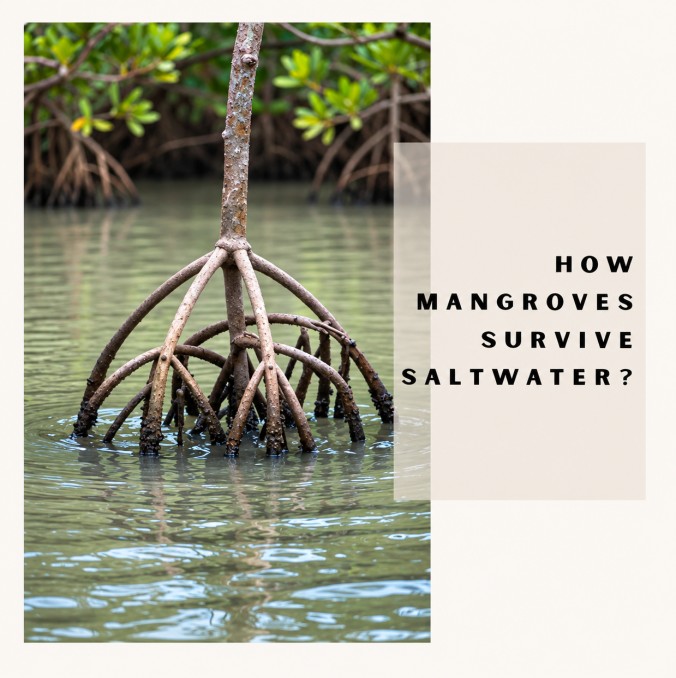
Mangrove forests are easily recognised by their unusual root systems.Depending on the species, roots may extend above the sediment or spread through soft, waterlogged soils. These structures help anchor trees in unstable coastal sediments and can also assist with gas exchange where oxygen availability in the soil is limited.
The roots have another important function—they create habitat. Fish, crabs, crustaceans and other organisms can use the spaces created by mangrove roots for shelter and feeding. What begins as an adaptation for the survival of a tree therefore becomes an important feature of an entire ecosystem.
Why Mangrove Adaptations Matter
The ability of mangroves to survive saltwater allows them to occupy coastal environments that many other plants cannot tolerate. In doing so, they create productive ecosystems that support biodiversity while also helping stabilise coastlines and provide natural coastal protection.
Mangroves demonstrate the remarkable ability of life to adapt to challenging environments. Their salt tolerance is not based on one single feature but on a combination of physiological and structural adaptations. Protecting mangroves means protecting the extraordinary biological systems that allow these coastal forests to survive.