How Do Sea Turtles Find Their Way Home?
Introduction
Imagine travelling thousands of kilometres across the ocean without a map, compass or GPS and still being able to find your way towards the region where you began. For sea turtles, this extraordinary ability is part of their natural navigation system. Their journeys have fascinated scientists because these animals appear to use information from the natural environment to orient themselves across vast stretches of ocean.
How Do Sea Turtles Find Their Way Home?
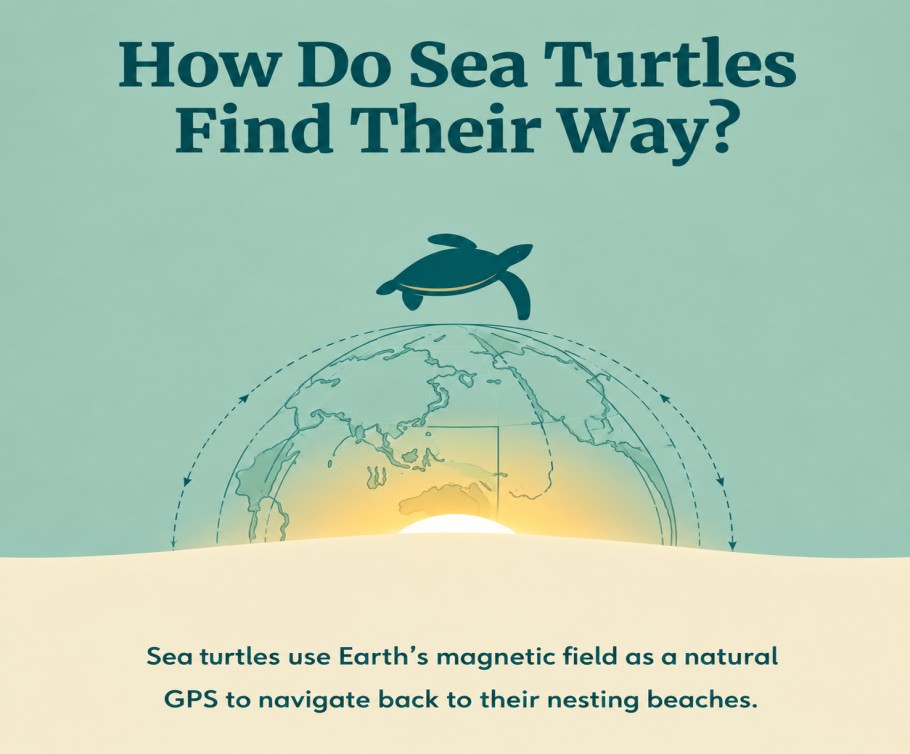
One of the most fascinating abilities involved in this process is magnetoreception. Sea turtles can sense information associated with Earth's magnetic field, allowing them to use an invisible environmental signal during their long-distance movements. Their navigation demonstrates just how closely marine animals can interact with Earth's physical systems.
What Is Magnetoreception?
Magnetoreception is the ability to detect information associated with Earth's magnetic field. The magnetic field is not identical everywhere on Earth; characteristics such as intensity and inclination vary geographically. Sea turtles can detect differences in these magnetic characteristics, providing information that can contribute to orientation and navigation.
Scientists have also studied the concept of geomagnetic imprinting. Young turtles may become familiar with the magnetic characteristics associated with their early-life environment. Later, these cues may help them navigate towards their natal region when they become adults and begin reproductive migrations. This creates a remarkable connection between a turtle's early life and its future movements.
Earth's Magnetic Field as a Natural Map
The Earth's magnetic field can be thought of as an invisible environmental information system. Sea turtles do not see this magnetic field in the way humans see a road sign, but their sensory abilities allow them to detect relevant characteristics. Differences in magnetic intensity and inclination can provide clues about geographical position and direction.
However, magnetic information is not necessarily the only tool sea turtles use. As they move closer to coastal areas, they may also respond to ocean currents, wave direction and other environmental signals. Scientists are still working to understand how these different cues interact and how sea turtles combine them during their journeys.
Why This Matters for Conservation
The remarkable navigation abilities of sea turtles also highlight the importance of protecting their natural environments. A turtle may travel enormous distances and successfully return towards its natal region, only to encounter a degraded or heavily disturbed nesting beach. Conservation therefore needs to protect the places where turtles reproduce as well as the marine environments through which they travel.
Understanding magnetoreception also reminds us that the natural world contains many systems that humans cannot easily see. A coastline may look like an ordinary beach to us, but to a sea turtle it can be part of a lifelong navigational connection. Protecting nesting beaches means protecting the destinations of journeys that may have begun decades earlier.