SEA TURTLE MAGNETORECEPTION
Introduction
The ocean does not provide sea turtles with roads, signboards or visible landmarks stretching across thousands of kilometres. Yet these animals are capable of remarkable long-distance movements between different parts of the marine environment. One of the abilities that helps explain this extraordinary behaviour is magnetoreception—the ability to sense information associated with Earth's magnetic field.
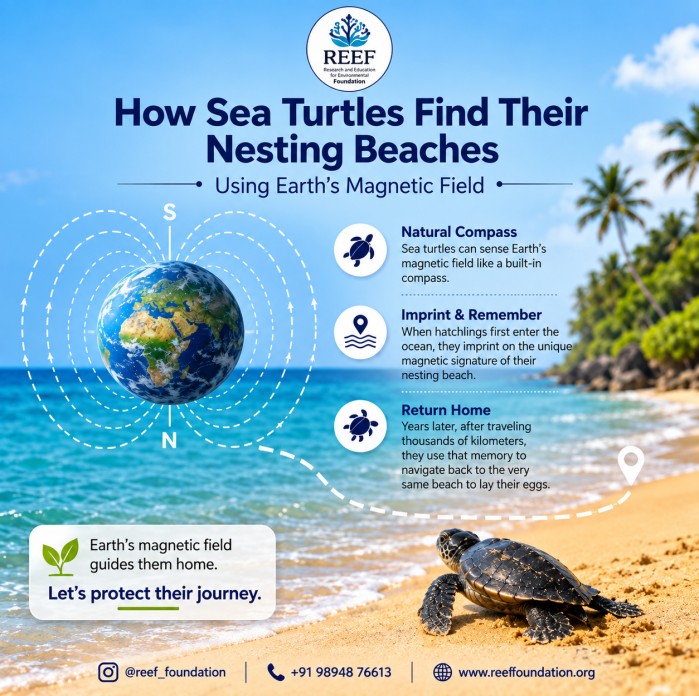
Sea Turtle Magnetoreception: Nature's Invisible Navigation System
For scientists, sea turtle magnetoreception is fascinating because it connects animal behaviour with Earth's physical environment. The magnetic field surrounding our planet is invisible to humans, but sea turtles can detect characteristics of it that provide useful information during navigation.
How Does the Magnetic Field Help?
Earth's magnetic field varies geographically. Sea turtles can detect differences in characteristics such as magnetic intensity and inclination. These differences can provide information that helps turtles determine direction and their approximate geographical location.
This ability is particularly important during long-distance movements across open water. Instead of relying on a single visible landmark, turtles can use environmental information that is present across the ocean. Researchers continue to investigate exactly how their sensory systems detect magnetic information and how this information is processed.
Geomagnetic Imprinting and Other Cues
One important concept associated with sea turtle navigation is geomagnetic imprinting. Young turtles may become familiar with the magnetic characteristics of the region where they begin life. Later, when they undertake reproductive migrations, these learned magnetic cues may help guide them towards their natal region.
Magnetic cues are not necessarily the only navigation signals available to sea turtles. As they approach coastal areas, they may also use wave direction, ocean currents and possibly chemical cues. This combination of environmental information makes sea turtle navigation a complex biological process that scientists are still working to fully understand.
Why Sea Turtle Navigation Matters for Conservation
Understanding magnetoreception gives us a deeper appreciation of the relationship between sea turtles and their habitats. A nesting beach is not simply a location where eggs are deposited. It can be part of a geographical and environmental connection that influences a turtle's movements throughout its life.
If nesting beaches are degraded or heavily disturbed, the success of this remarkable natural journey can be affected. Protecting beaches, coastal habitats and marine environments is therefore essential. Nature's navigation system has guided sea turtles for generations—and protecting their habitats helps preserve that extraordinary journey.
Yes. For REEF, “Life Cycle of a Sea Turtle” is an excellent SEO topic because it can attract students, parents, educators, marine biology learners, and general audiences.