Sea Turtles: Ancient Ocean Guardians
Introduction
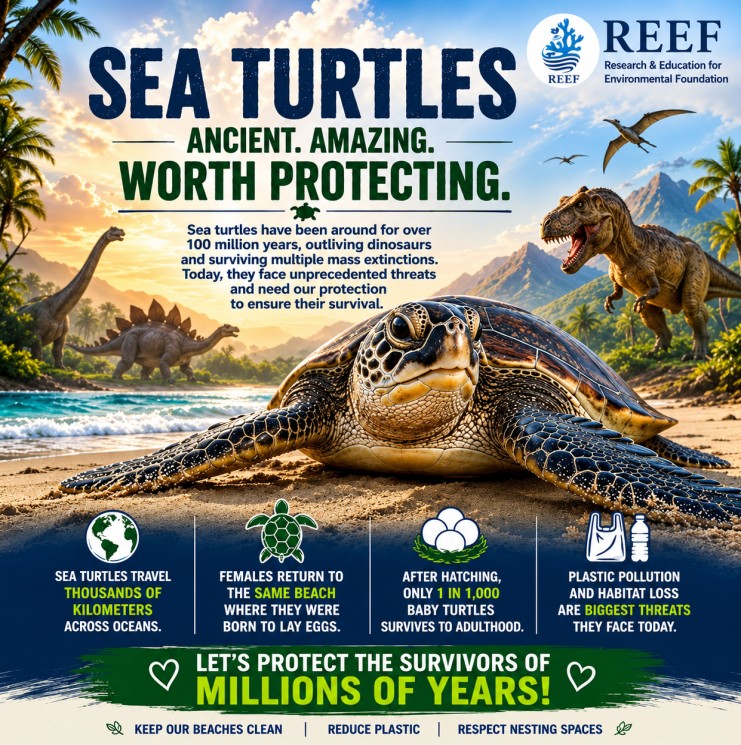
For more than 110 million years, sea turtles have travelled through the world's oceans. They have survived dramatic environmental changes and the extinction of dinosaurs, making them one of the most ancient groups of marine animals still living today. Their long evolutionary history tells a remarkable story of survival, adaptation and resilience. Yet the challenges they face today are increasingly linked to human activities.
Sea Turtles: Ancient Ocean Guardians
Modern sea turtle populations are affected by plastic pollution, fishing gear, bycatch, coastal development, artificial lighting, climate change and illegal harvesting. Six of the seven sea turtle species are listed as Vulnerable, Endangered or Critically Endangered. This makes sea turtle conservation an urgent environmental priority, particularly because their survival depends on healthy oceans as well as safe nesting beaches.
Why Are Sea Turtles Important?
Sea turtles are more than beautiful animals that inhabit the ocean. They are connected to several important marine and coastal ecosystems. Green sea turtles interact with seagrass meadows through their grazing, hawksbill turtles feed on marine sponges associated with coral reefs, and leatherback turtles are important predators of jellyfish. Through these relationships, sea turtles contribute to the natural functioning of marine food webs and habitats.
Their ecological role also extends onto land. When sea turtles nest, some eggs fail to hatch and eggshells remain within the sand. These materials contribute nutrients to coastal ecosystems and demonstrate the connection between marine animals and terrestrial environments. Protecting sea turtles therefore means protecting a network of ecological relationships rather than simply conserving one species.
Threats Facing Sea Turtles
Sea turtles face threats at almost every stage of their lives. Plastic waste can create ingestion and entanglement risks, while fishing nets and other fishing equipment can accidentally capture turtles. Coastal development can alter nesting habitats, and artificial lighting can interfere with natural behaviour on beaches. These pressures become particularly serious because sea turtles depend on different habitats during different stages of their lives.
Climate change creates additional challenges for sea turtle populations by affecting coastal environments and the conditions on which their habitats depend. Illegal harvesting of turtles and eggs can also directly affect populations. Because sea turtles travel between nesting beaches, coastal waters, feeding grounds and open-ocean environments, conservation must extend across these connected habitats.
REEF's Commitment to Sea Turtle Conservation
The Institute of Sea Turtle Conservation (ISC), an initiative of the Research & Education for Environmental Foundation (REEF), is dedicated to protecting sea turtles and their nesting habitats along the Pulicat coast. REEF combines conservation research, field-based monitoring, environmental education and community participation to support long-term marine conservation.
REEF's activities include sea turtle nesting beach monitoring, biodiversity assessments, rescue and protection of stranded turtles, community awareness, school outreach programmes, student training, internships and capacity-building in marine conservation. These activities help connect scientific research with practical conservation and provide opportunities for students and communities to become involved in protecting marine biodiversity.
Protecting the Future of Sea Turtles
Sea turtles have survived for millions of years, but their future now depends greatly on how humans manage coastal and marine environments. Conservation requires long-term monitoring, scientific research, responsible coastal management and community awareness. Protecting nesting beaches is important, but so is reducing threats in the ocean where turtles spend much of their lives.
Every protected nest represents another generation of turtles. Every rescued turtle represents an opportunity for survival. Every person who learns about sea turtle conservation can become part of a larger conservation effort. When we protect sea turtles, we protect the future of our oceans.
Frequently Asked Questions
Why are sea turtles important to marine ecosystems?
Sea turtles contribute to seagrass ecosystems, coral reef communities, marine food webs and coastal nutrient cycling.
What are the major threats to sea turtles?
Plastic pollution, fishing gear, bycatch, coastal development, artificial lighting, climate change and illegal harvesting are major threats.
Where does REEF work on sea turtle conservation?
REEF's Institute of Sea Turtle Conservation works along the Pulicat coast.
How can students participate?
Students can participate through research, training, internships, field activities and environmental education programmes.