Mangroves: Nature's Coastal Guardians
Introduction
Where rivers, wetlands and coastal waters meet, mangroves create one of the most specialised ecosystems on Earth. These salt-tolerant trees thrive in environments shaped by tides and changing water conditions, creating forests that connect terrestrial and marine ecosystems.
Mangroves: Nature's Coastal Guardians
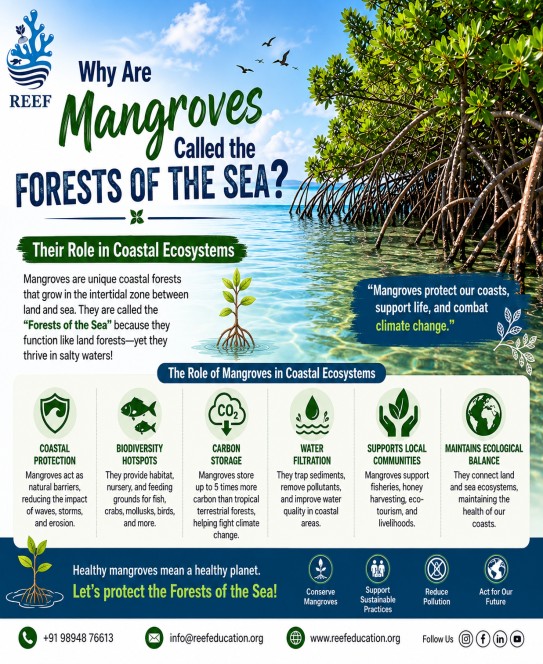
Mangroves are essential for biodiversity, climate resilience and coastal protection. They provide habitat for wildlife, help stabilise shorelines and contribute to carbon storage. REEF recognises the importance of these ecosystems and works towards their conservation and restoration through research, education and community participation.
Mangroves as Coastal Guardians
One of the most important functions of mangroves is their relationship with coastlines. Their complex root systems help trap and stabilise sediments, contributing to shoreline stability and reducing erosion. The vegetation also creates a natural barrier between land and sea, making mangrove forests important components of resilient coastal environments.
Mangroves also provide habitat for a wide range of organisms. Fish, crustaceans, birds and other wildlife can use mangrove forests for shelter, feeding and nursery habitat. This makes mangrove ecosystems important not only for the trees themselves but also for the biodiversity that depends on them.
Mangroves and Blue Carbon
Mangroves are increasingly recognised for their role in blue carbon ecosystems. Through photosynthesis, mangrove vegetation captures carbon, while carbon can also be stored within coastal sediments. This makes healthy mangrove forests valuable components of natural climate solutions.
Despite their importance, mangroves are globally limited in extent. They occur across more than 120 tropical and subtropical nations and territories, but account for less than 1% of tropical forests worldwide. FAO's assessment reported a global mangrove extent of approximately 14.8 million hectares in 2020.
Threats to Mangrove Ecosystems
Mangrove forests continue to face pressure from human activities and environmental changes. Aquaculture, agriculture, urban development and infrastructure can result in mangrove conversion and habitat loss. Climate-related changes can also influence the condition and distribution of mangrove ecosystems.
The loss of mangroves can have consequences far beyond the trees themselves. When mangrove habitats disappear, coastal biodiversity, shoreline stability, carbon storage and ecosystem services can also be affected. Protecting existing forests and restoring degraded areas are therefore important parts of long-term coastal conservation.
REEF's Approach to Mangrove Conservation
REEF works towards mangrove conservation and restoration through research, education and community participation. This approach recognises that long-term conservation requires scientific understanding as well as awareness and involvement from the people who interact with coastal ecosystems.
Mangroves may occupy relatively narrow areas along coastlines, but their influence extends far beyond their boundaries. They connect land and sea, support biodiversity, store carbon and strengthen coastal resilience. Protect mangroves. Protect our coasts. Protect our future.